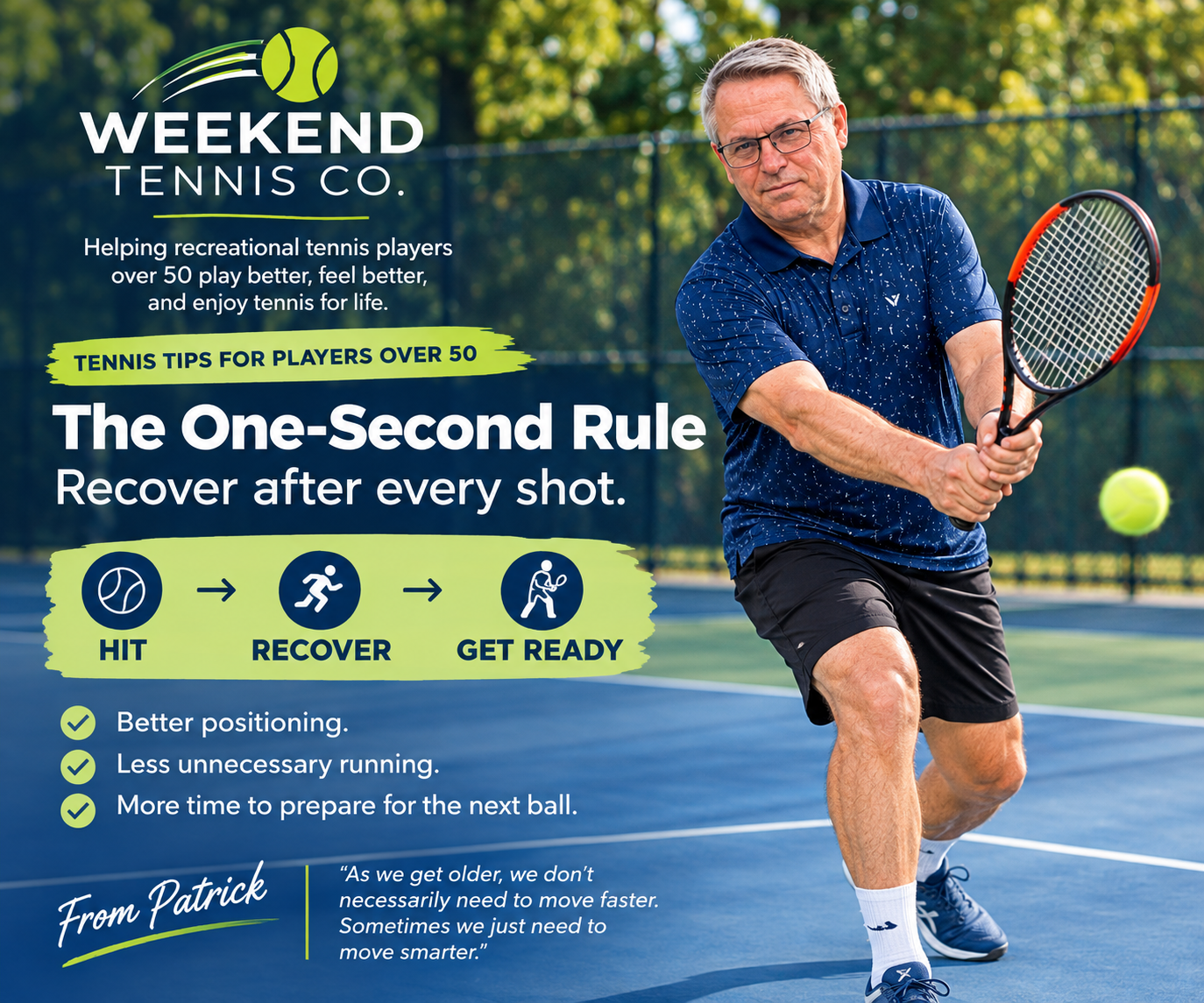
Better positioning. Less unnecessary running. More time to prepare for the next ball.
If you’ve been playing tennis for a while, you’ve probably had this happen:
You hit what you think is a great shot.
You watch it travel across the court.
You wait to see what your opponent does with it.
And then…
Oh! They’re hitting it back!
Now you’re scrambling to get into position.
I’ve been guilty of this myself.
As we get older, we may not move around the court quite as quickly as we once did. But that doesn’t mean we can’t cover the court effectively.
Sometimes the answer isn’t moving faster.
It’s starting sooner.
That’s where I like to use what I call the One-Second Rule.
Table of Contents
ToggleWhat Is the One-Second Rule?
It’s very simple:
Hit → Recover → Get Ready
After you hit the ball, don’t stand there watching it.
Start your recovery immediately.
You don’t need to sprint back to your exact starting position. You simply want to begin moving toward a good position for your opponent’s next shot.
That first second matters.
It gives you time to:
- Get yourself back into a better position
- Get balanced
- Prepare your racquet
- Read your opponent
- Be ready to move in either direction
Instead of reacting to the next shot from a standing start, you’re already moving.
Why This Matters More as We Get Older
When we’re younger, we can sometimes get away with poor positioning because we can make up for it with speed.
At 25, you might hit a ball, admire it for a second, and still have plenty of time to chase down the next one.
At 55?
Maybe not quite so much. 😄
That’s not necessarily a bad thing.
It just means that positioning, anticipation and efficient movement become more important.
We’re not trying to turn ourselves into professional tennis players.
We’re trying to make the most of the body and game we have today.
And there’s something satisfying about that.
We don’t necessarily have to move faster. We can learn to move smarter.
Don’t Watch Your Shot
This is probably the hardest part of the habit.
When you hit a great forehand, it’s tempting to watch it.
Did it land in?
Did it hit the corner?
Did your opponent get to it?
Was it a winner?
Of course we want to know!
But you don’t need to watch the entire flight of your ball.
Once you’ve made contact, your job changes.
The ball is now on its way to your opponent.
Your next job is to prepare for what comes back.
Think:
Hit the ball → eyes up → recover → ready position.
Your opponent’s response will tell you whether your shot was as good as you thought it was. 😉
You Don’t Have to Run All the Way Back
There’s another important point here.
Recovery doesn’t always mean returning to exactly where you started.
Your ideal position depends on:
- Where you hit the ball
- Where your opponent is
- Whether you’re playing singles or doubles
- Whether you’re approaching the net
- Whether you’re pulled wide
- Whether your shot was defensive or offensive
The goal is simply to recover toward a position that gives you the best chance of handling the next ball.
That’s smarter movement.
A Simple Practice Drill
You don’t need a coach or any special equipment for this one.
The next time you’re warming up, give this a try.
Step 1: Hit
Hit a normal groundstroke.
Don’t worry about power. Just hit a comfortable shot.
Step 2: Recover
The instant you make contact, start moving back toward your ready position.
Don’t wait to see where the ball lands.
Step 3: Get Ready
Get balanced, get your racquet up and prepare for the next ball.
Then repeat.
Hit → Recover → Get Ready.
Do this for a few minutes during a warm-up or hitting session.
At first, you’ll probably have to think about it.
After a while, it should start becoming automatic.
Try It in a Doubles Game
This is particularly useful in doubles.
After you hit your shot, don’t admire it.
Recover and get ready.
Your opponent may return the ball sooner than you expect, and being prepared can make the difference between an easy volley and a desperate reaction.
It also helps you stay involved in the point instead of mentally switching off after your shot.
A Little More Patience Can Save a Lot of Running
One of the things I like about this idea is that it isn’t really about fitness.
It’s about efficiency.
If you consistently recover after your shots, you may find yourself reaching more balls without feeling like you’re constantly sprinting around the court.
You’re giving yourself a head start.
And for recreational players over 50, those little advantages can add up.
From Patrick
I’ll be honest—this is one of those habits I wish I’d developed earlier.
I’ve definitely had plenty of moments where I’ve hit a shot and watched it instead of immediately thinking about the next ball.
But the older I get, the more I appreciate how much positioning and anticipation can compensate for a little lost speed.
I’m not trying to play tennis like I did when I was 25.
I’m trying to play the best tennis I can now.
And sometimes that means working smarter instead of harder.
Give the One-Second Rule a try the next time you’re on court.
Hit → Recover → Get Ready.
You might be surprised how much difference that little habit makes.
Final Takeaway
You don’t have to be the fastest player on the court.
You just need to avoid giving your opponent an unnecessary head start.
After every shot, start thinking about the next one.
🎾 Hit. Recover. Get Ready.
Small changes can make a big difference.
Leave a Reply